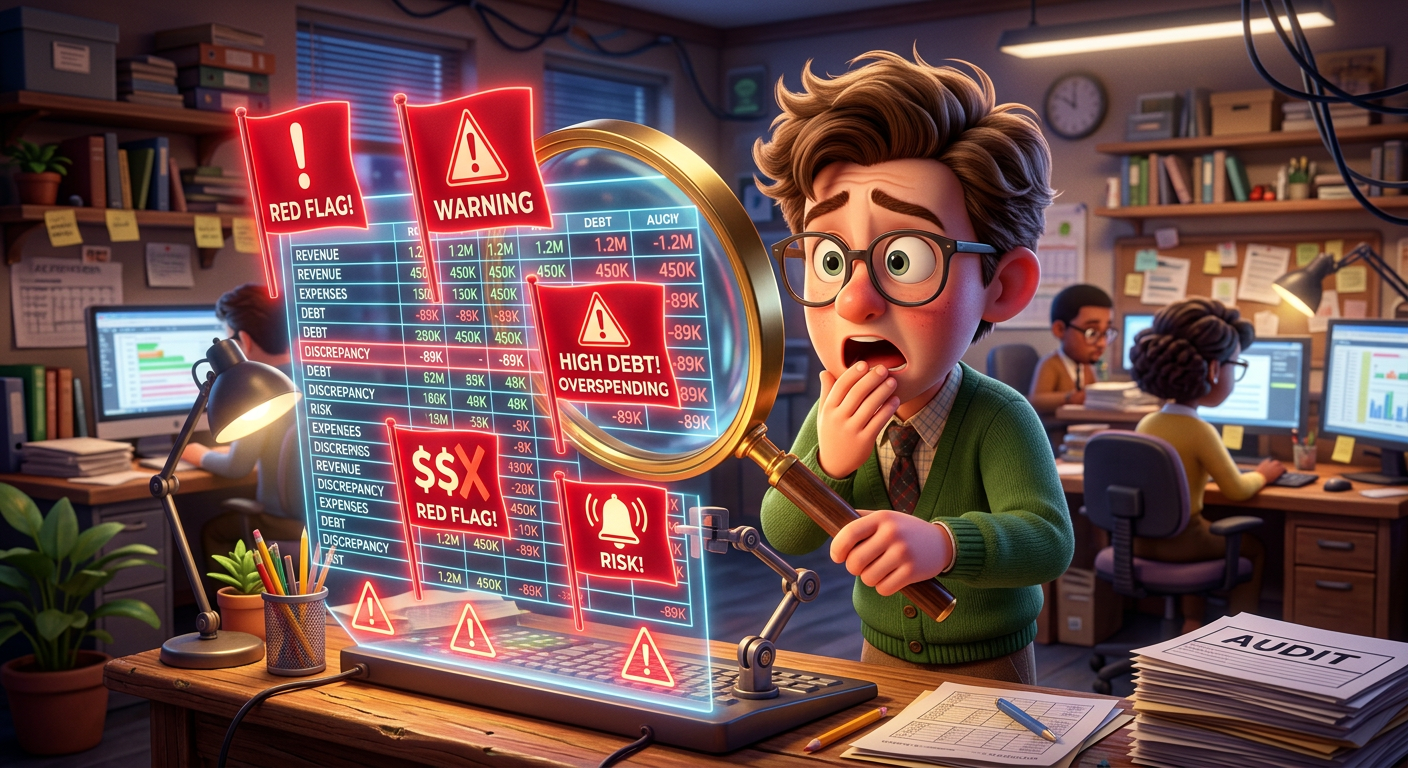
Spotting the Warning Signs: 7 Red Flags in Financial Statement Analysis
Whether you are an investor, a business owner, or a financial analyst, reading a company’s financial statements is like reading its vital signs. While corporate executives will naturally try to present their company in the best possible light, the raw numbers rarely lie [1].
Recognizing early warning signs—or “red flags”—can save you from disastrous investments or help you pivot your business strategy before it’s too late. Here are the critical red flags to watch for in financial statement analysis.
1. Inconsistent or Negative Operating Cash Flow
A company can look highly profitable on its income statement but still go bankrupt if it runs out of cash. The most serious red flag is when cash flow from operations is consistently negative or highly erratic, even if net income looks stable [2]. This points to deep liquidity problems and often stems from slow collections, inventory buildup, or an inability to convert sales into actual cash.
2. Current Liabilities Exceeding Current Assets
The “current ratio” measures a company’s ability to pay its short-term obligations with its short-term assets. If this ratio falls below 1.0, it means the company has more bills due in the next 12 months than it has cash or liquid assets to pay them [1]. A consistent trend below 1.0 implies the company is relying heavily on short-term borrowing or delaying payments to suppliers just to keep the lights on.
3. Rising Debt-to-Equity Ratios
Taking on debt to finance growth is normal, but it becomes a massive red flag when a company’s debt-to-equity ratio rises while revenue and earnings growth stagnate [1]. This indicates the company is borrowing just to survive, rather than to expand. If the company struggles to service this debt, it risks violating debt covenants, which can trigger a catastrophic debt spiral.
4. Declining Profit Margins and Revenue Drops
Unexplained drops in revenue or consistently shrinking profit margins are clear indicators of weakening operating performance. This could signal intense competitive pressures, weakening market demand, or rising costs that the company cannot pass on to consumers [3].
5. Sudden Changes in Accounting Policies
“Creative accounting” is a desperate attempt to manipulate how a company appears on paper. Unexplained shifts in accounting methods, such as changing how revenue is recognized or how inventory is valued, are glaring red flags [3][4]. Another common manipulation is aggressive expense capitalization, which artificially decreases current expenses by distributing them over future periods [5].
6. Frequent Related-Party Transactions
When a company frequently engages in transactions with its executives, major shareholders, or affiliated companies, it raises concerns about conflicts of interest and transparency. These transactions can be used to siphon money out of the company or artificially inflate revenues [3].
7. Financial Reporting Delays
Timely reporting is the backbone of a healthy business. If a company consistently delays the release of its financial statements, or relies on outdated, manual spreadsheet tracking, it is a massive warning sign [2][4]. Delays often mean the accounting team is struggling to reconcile the numbers, or worse, management is fighting with auditors over how to present bad news.
Conclusion
Financial statements tell a story, and it is crucial to read between the lines. By proactively monitoring these red flags—from cash flow discrepancies to questionable accounting shifts—you can identify financial distress early, mitigate risks, and make informed, confident decisions.
Sources
[1] 16 Red Flags to Watch for in a Company’s Financial Statements (insights.aaii.com)
[2] Red Flags in Financial Statements You Shouldn’t Ignore (gullacpa.com)
[3] Critical Red Flags in Financial Statement Reviews | Weaver (weaver.com)
[4] Financial Distress: Recognizing Early Warning Signs (sdmayer.com)
[5] Accounting Warning Signs | CFA Level 1 – AnalystPrep (analystprep.com)